“Several years ago, writer Du Daobin posted several essays on the internet, protesting such things as unfair taxes and the corruption of the media. He was then charged with ‘inciting subversion of state power,’ arrested, and after many legal twists and turns, tortured in prison. Daobin, along with several other dissidents with similar stories, decided to sue Cisco Systems (PDF) earlier this year under the legal theory that it aided and abetted China’s violation of the Torture Victim Protection Act of 1991. As the case moves forward, the Chinese Ministry of Public Security has stepped up its surveillance, harassment, and interrogation of Daobin and the others. The Electronic Frontier Foundation has now joined the Laogai Research Foundation to draw attention to the case. As part of its opening move, it has asked Cisco to make public statements in support of human rights, hoping that the company’s influence with the Chinese government will provide some modicum of protection for the threatened dissidents.”
There are multiple ways to bypass the Chinese Firewall, using VPN, anonymous browsers or Tor. But I prefer to use the most simple way, which for me is using an ssh tunnel.
host:~user$ ssh -D 8888 login@myserver.org
(There is also a nice GUI for those who are not familiar with the command line.)
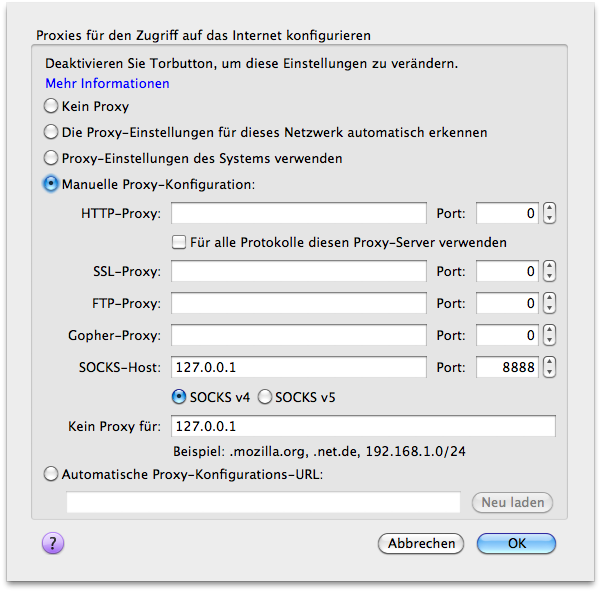
Then I configure my system preferences to use the socks proxy on 127.0.0.1:8888, which can also be done in Firefox Network settings. (see screenshots)
As the Chinese Government also tries to block external sites, such as Youtube and Openleaks, by filtering DNS requests, it’s necessary to filter this too. One could e.g. point them to 127.0.0.1 (in system preferences) and then send through another ssh tunnel:
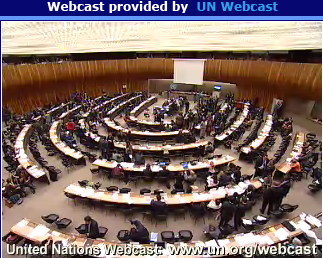
From 3rd to 25th March 2008 the 7th Session of the UN human rights council is taking place. Today some of the deligates have made remarks about the current situation in Tibet. And have challenged the chinese delegation to make a statement. Watch the live webcast on the UN-HRC website.
Human rights in China and the Beijing Olympics
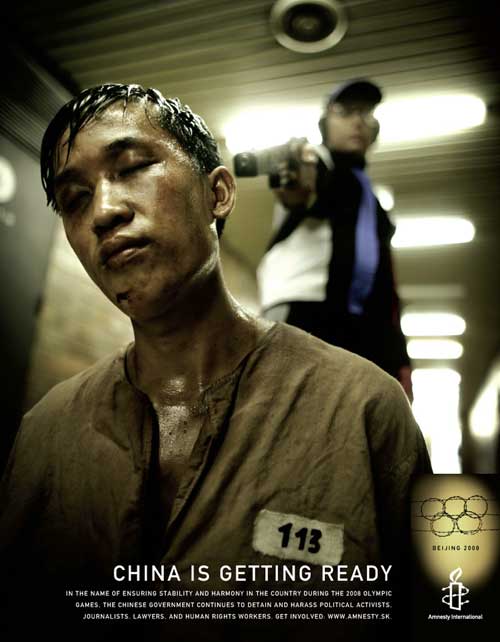
As the clock ticks down to the start of the Beijing Olympics, Amnesty International is hopeful the event can create a positive human rights legacy for the people of China.
The Chinese government have promised action. Now the ball is in their court.
There are high expectations that the Games will spark improvements in China’s human rights record. When Beijing was chosen as the host city for the Games, both the Chinese authorities and the International Olympic Committee (IOC) spoke publicly of the “unique legacy” it would leave to China and to sport. This included progress in human rights.
Although there have been some positive changes since then, such as a reform of the death penalty system and greater reporting freedom for foreign journalists, these have been overshadowed by a deterioration in other areas.
The Games are being used as a justification to extend the use of detention without trial in Beijing as part of the city’s “clean-up” ahead of August 2008. Meanwhile, human rights activists are increasingly subjected to harassment, house arrest and unfair trials.
“Several years ago, writer Du Daobin posted several essays on the internet, protesting such things as unfair taxes and the corruption of the media. He was then charged with ‘inciting subversion of state power,’ arrested, and after many legal twists and turns, tortured in prison. Daobin, along with several other dissidents with similar stories, decided to sue Cisco Systems (PDF) earlier this year under the legal theory that it aided and abetted China’s violation of the Torture Victim Protection Act of 1991. As the case moves forward, the Chinese Ministry of Public Security has stepped up its surveillance, harassment, and interrogation of Daobin and the others. The Electronic Frontier Foundation has now joined the Laogai Research Foundation to draw attention to the case. As part of its opening move, it has asked Cisco to make public statements in support of human rights, hoping that the company’s influence with the Chinese government will provide some modicum of protection for the threatened dissidents.”